Hair Transplant in Gurgaon: FUE vs DHI vs FUT, Which Technique Is Right for You
Table of Contents
Ritika Sabharwal is 36, teaches at a school near Sector 56, and has spent the last two months reading everything she can find about hair transplant techniques after her husband Amit started losing density along his crown. Every article she opens uses a different acronym, FUE, DHI, FUT, and every clinic website seems to claim its own method is the best one available. What she actually wants is a straight answer on which technique fits Amit’s degree of thinning, not another glossary of terms.
Confused about which hair transplant technique suits your hair loss pattern? Message Aesthetics Redefined by Cocoona on Golf Course Road on WhatsApp or call +91 9560801896 for a technique specific assessment. Choosing between FUE, DHI, and FUT hair transplants in Gurgaon depends entirely on your specific hair loss grade and donor area density. While FUE and DHI offer scarless extraction for moderate thinning, FUT remains highly effective for advanced hair restoration. Learn how modern surgical execution impacts follicle survival rates below.
What FUE, DHI and FUT Actually Mean
FUE, Follicular Unit Extraction, harvests individual follicular units from the donor area at the back of the scalp without leaving a linear scar. FUT, Follicular Unit Transplantation, removes a thin strip of scalp tissue and dissects it into grafts, leaving a linear scar that hair usually covers. DHI, Direct Hair Implantation, is a refined version of FUE using a Choi implanter pen (the use of which protects the fragile hair bulb from mechanical trauma during placement) for simultaneous extraction and implantation, reducing the time each follicle spends outside the body.
FUE vs DHI vs FUT: Hair Transplant Techniques Compared
| Factor | FUE | DHI | FUT |
|---|---|---|---|
| Scarring | Minimal dot scars, not visible | Minimal, similar to FUE | Linear scar, usually hidden by hair |
| Graft Survival | High with skilled surgeon | Higher due to reduced handling time | High but depends on strip handling |
| Best Suited For | Moderate to advanced hair loss, larger areas | Smaller areas needing precise density | Cases needing very high graft counts |
| Downtime | 7 to 10 days | 7 to 10 days, procedure itself is faster | 10 to 14 days |
| Hair Transplant cost in Gurgaon | Rs 40,000 to Rs 1,20,000 | Rs 60,000 to Rs 1,50,000 | Rs 40,000 to Rs 1,00,000 |
Choosing the Right Hair Transplant Technique for Your Stage of Hair Loss
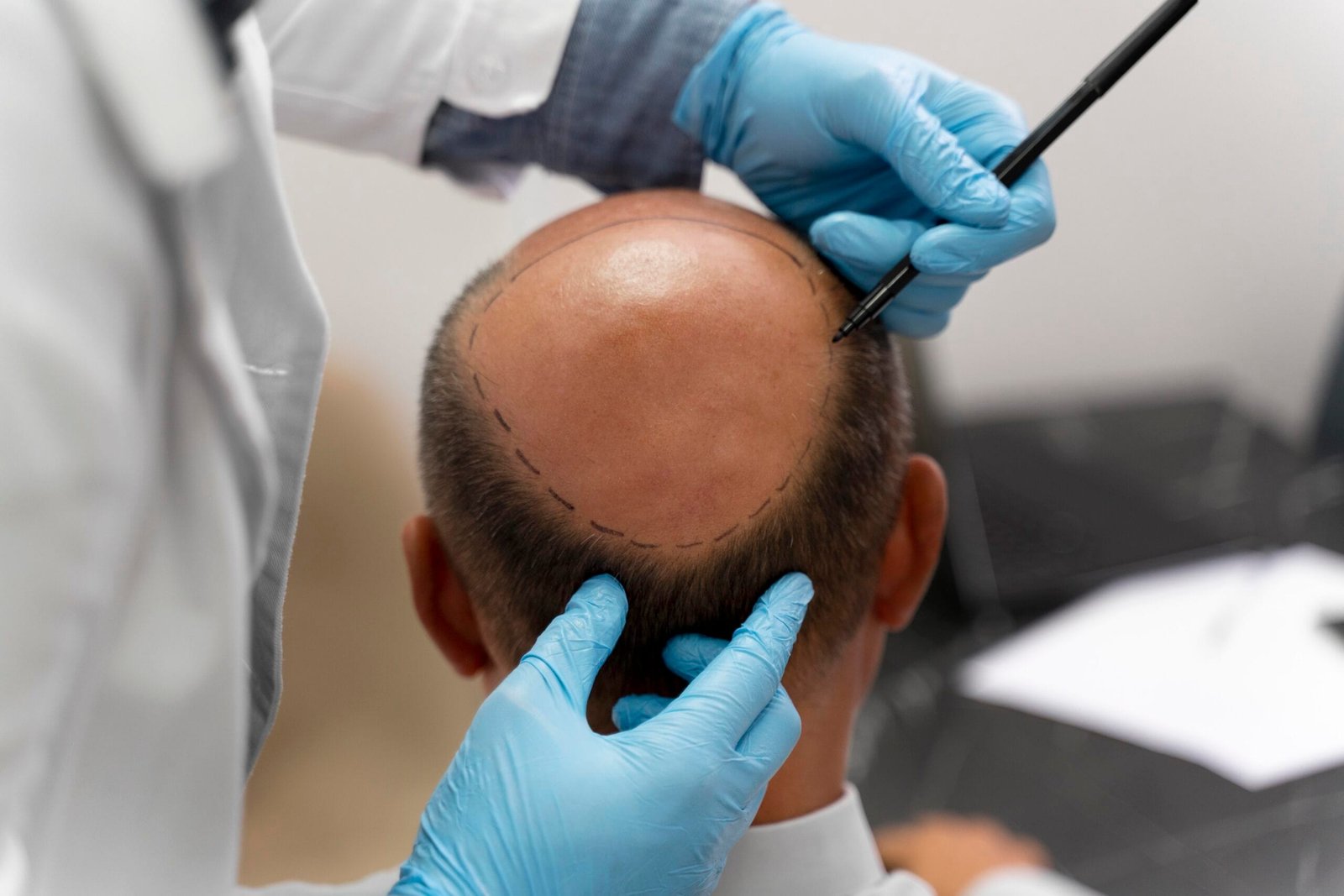
For Amit’s crown thinning, which covers a moderate area with reasonably dense donor hair, FUE alone or FUE combined with DHI for the hairline zone tends to give the most balanced outcome. Norwood Grade 2 to 3 cases with early hairline recession usually respond well to DHI for its precision in low density zones. Advanced Norwood Grade 4 and above, needing very high graft counts in one sitting, is where FUT sometimes becomes the more practical choice despite the scar trade off, since it can yield more grafts per session. There is no single ‘best’ hair transplant technique; there is only the mathematically correct choice for your donor profile. A premium result balances maximizing graft survival with minimizing donor-zone depletion, ensuring you retain coverage options for the future.
Why the Technique Name Matters Less Than the Surgeon Behind It
Most well run clinics today combine FUE and DHI within the same session rather than treating them as separate offerings, using DHI specifically for hairline precision and FUE for broader coverage. What actually determines your outcome is graft survival, which depends far more on out of body time and surgical handling than on which acronym is printed on your invoice. Dr Kriti Lohia assesses various factors including Vitamin D, Ferritin, Thyroid disorders, Active dandruff, Seborrhoeic dermatitis, Alopecia areata and Active telogen effluvium before deciding upon the treatment which optimises the results.
The Real Factor Behind Every Technique: Graft Survival
A well performed procedure targets over 95 percent graft survival regardless of technique. At 80 percent survival, several hundred fewer follicles grow from the same graft count, which is the actual difference between a good result and an excellent one. Dr Kriti Lohia, India’s leading American Board Certified Regenerative Medicine Expert in Dermatology, has performed hair transplants for over 10 years across FUE, DHI and FUT, and selects the technique based on donor density, hair loss grade and recipient area rather than a fixed clinic preference. Her unique strength of regenrative medicine helps in pre-transplant optimisation, improving scalp health, managing active hair loss, supporting healing in selected patients and long-term maintenance.
Choosing between FUE, DHI and FUT is ultimately a surgical judgment call, one shaped here by Dr. Sanjay Parashar, Founder and Chairman of Cocoona Centre for Aesthetic Transformation, who has performed over 12,000 procedures across cosmetic and reconstructive surgery. His technique selection is based on donor density and case complexity, not a single default method. Furthermore more than the technique, more important is hairline design, angle, direction, density, graft handling, recipient site creation, donor harvesting and aesthetic judgement where Dr Sanjay Parashar is unparalled.
Not sure whether FUE, DHI or FUT suits your hair loss pattern? Schedule a detailed physical scalp evaluation at our Aesthetics Redefined Golf Course Road Gurugram Clinic to see real patient before-and-after portfolios. Message on WhatsApp or call +91 9560801896 to book your technique specific consultation.
The right technique is the one matched to your donor area and hair loss stage, not the one trending on a clinic’s homepage. A proper assessment tells you that in one visit.
People Also Ask
Can FUE and DHI be combined in a single hair transplant session in Gurgaon?
Yes, most experienced Gurgaon clinics combine both within one session, using DHI for hairline density and FUE for broader recipient coverage, rather than offering them as entirely separate procedures.
Which technique leaves the least visible scar for short haircuts?
FUE and DHI both leave minimal dot scarring that is generally not visible even with short haircuts, while FUT leaves a linear scar along the donor strip that some men prefer to avoid if they keep their hair very short.
