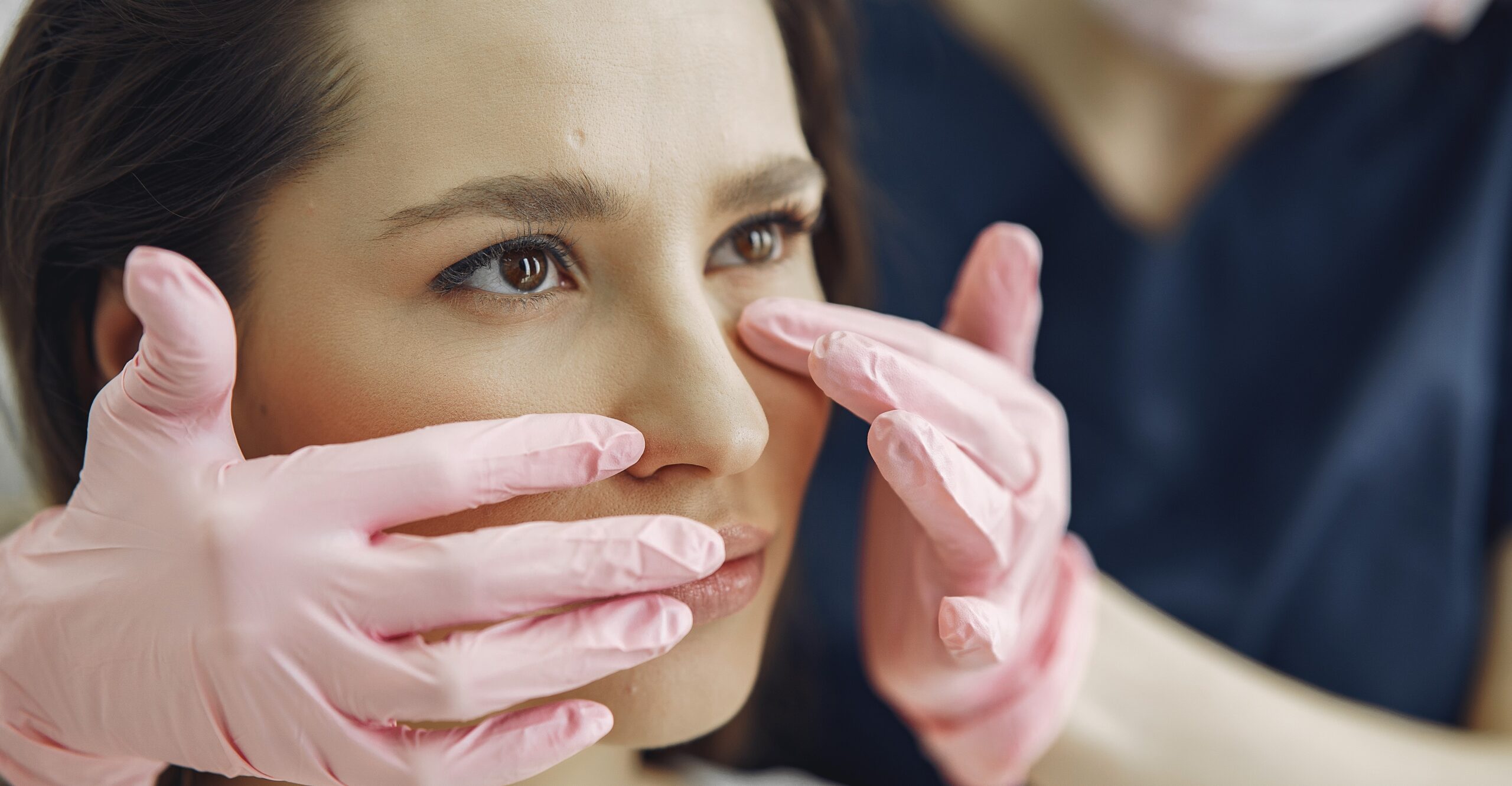
How to Remove Cholesterol Deposits Around Eyes: Top Gurgaon Dermatologist Recommends
Table of Contents
Have you noticed small yellowish patches forming near the inner corners of your eyes or along your eyelids? Maybe a colleague at your office in Sector 54 pointed it out, or you caught them in a mirror before a family event. These are likely xanthelasma palpebrarum, slightly raised lipid deposits that form when cholesterol-carrying macrophages accumulate in the periorbital dermis. You will not feel any discomfort from them, and they pose no malignant risk. The concern is cosmetic and metabolic, and in Gurgaon’s social and professional environment, where you are frequently under close-range lighting at client meetings or family gatherings, most people want them addressed sooner rather than later.
Concerned about yellow patches near your eyes? Contact Aesthetics Redefined by Cocoona on Golf Course Road for a dermatologist-led assessment. Call us at +91 9560801896 or message us on WhatsApp to book your consultation today.
Why Xanthelasma Appears and Who Is at Risk
Xanthelasma develops when low-density lipoprotein (LDL) particles, sometimes called bad cholesterol, infiltrate the skin around the eyes. Foam cells, which are lipid-filled macrophages, cluster at the level of the dermis and create visible yellowish plaques. Not everyone with xanthelasma has abnormal lipid levels, but a significant proportion may. People with diabetes and thyroid dysfunction are also at higher risk. This is why a dermatologist-led evaluation always includes a recommendation to check your lipid panel.
Residents across Paras Quartier, Golf Course Extension Road, and Heritage City often flag xanthelasma during routine skin consultations. Common risk factors include:
- Elevated LDL cholesterol or low HDL levels
- Type 2 diabetes or insulin resistance
- Hypothyroidism affecting lipid metabolism
- Genetic predisposition, particularly in South Asian populations
- Perimenopause-related hormonal shifts in women
If you have been noticing these deposits growing gradually over months, that pattern confirms the condition will not self-resolve.
Can Cholesterol Eye Deposits Go Away on Their Own?
Clinically, xanthelasma does not regress without intervention. Lipid deposits within the dermis do not dissolve through diet changes or exercise alone, though managing your systemic cholesterol levels may be essential to prevent new plaques from forming or existing ones from enlarging. Staying active and keeping your HDL numbers healthy is worth doing for a hundred reasons, but those deposits sitting in the dermis right now will not respond to a gym routine. They need a clinical hand.
Topical creams sold online as xanthelasma fixers have very little to no clinical backing, meaning they do not work. Applying unregulated acids this close to your eyes without professional oversight is genuinely risky and often leads to scarring. Many patients who try these products end up with skin irritation and patchy discolouration that takes longer to resolve than the deposits themselves. Save yourself that detour.
Xanthelasma Treatment Options in Gurgaon: Cream vs. Procedure vs. Surgery
Treatment selection depends on the size, depth, and location of the deposit, as well as your skin tone and healing profile. Here is a clinical comparison of available options:
| Method | Best For | Sessions / Recovery | Approx. Cost (Gurgaon) |
| TCA Peel | Very superficial deposits only; high recurrence rate, high chance of scarring, 15–20 days downtime | 2 to 3 sessions / 15 to 20 days | Rs 3,000 to Rs 6,000 per session |
| Nd:YAG Laser Treatment | Moderate deposits; high recurrence rate, risk of scarring on deeper lesions; requires multiple sessions | 2 to 3 sessions / 7 to 10 days | Rs 10,000 to Rs 25,000 |
| CO2 Laser (ablative mode only) | Limited effect on surface deposits; Er:YAG cannot reach deep lesions; CO2 in ablative mode carries scarring and recurrence risk; multiple sessions required | Multiple sessions / 7 to 14 days | Rs 10,000 to Rs 25,000 |
| Surgical Excision and Suture | All deposit types; highest success rate with minimal scarring; performed using RFA device, surgical blade, or CO2 laser in cutting mode; usually single session unless deposits are extremely deep | Single procedure / 10 to 14 days | Rs 15,000 to Rs 40,000 |
Surgical excision and suture using an RFA device is the most clinically reliable approach for xanthelasma in Gurgaon. The procedure removes the entire affected skin segment before closing the clean edges with sutures, which is why it delivers the highest success rate and the lowest risk of scarring among available options. CO2 laser can assist when used specifically in cutting mode during excision, but fractional CO2 or ablative CO2 on its own cannot remove the lesions and should not be confused with surgical excision.
Surgical excision and suture is appropriate across a wide range of deposit sizes and depths. When performed using an RFA device, it typically requires a single session, carries minimal scarring risk, and does not need repeat procedures unless the deposits are exceptionally deep.
What to Expect at the Clinic and Recovery Timeline
Vikram Sehgal is 46, a finance director based in M3M Golf Estate near Sector 65. He had been managing borderline cholesterol levels for two years when his wife noticed the pale yellow deposits forming above both eyelids. After a lipid panel confirmed dyslipidemia, he sought a skin specialist for removal. At Aesthetics Redefined, Dr. Kriti Lohia, India’s leading American Board Certified Regenerative Medicine Expert in Dermatology, assessed his plaque depth and recommended surgical excision and suture using the RFA device. The procedure was completed in a single visit and the treated area healed cleanly, with no visible scarring once the sutures were removed.
After surgical excision and suture, the area will have fine sutures in place for a few days while healing progresses. Gurgaon’s dust-heavy air, particularly along the Tata Primanti and Ireo Grand Arch commute corridors, makes keeping that area protected genuinely important. Avoid getting the sutures wet, skip eye makeup until your dermatologist confirms the site is closed, and apply broad-spectrum SPF every morning once the sutures are removed, since UV exposure on freshly healed periorbital skin can cause post-procedure darkening.
Ready to address those yellow patches near your eyes with a specialist who understands periorbital skin? Visit Aesthetics Redefined by Cocoona on Golf Course Road. Reach us at +91 9560801896 or connect via WhatsApp. Book your xanthelasma consultation today.
Xanthelasma is a visible condition, but it is also a manageable one when you work with a dermatologist who understands both the cosmetic and the metabolic dimensions of what you are seeing around your eyes.
People Also Ask
Why is my xanthelasma growing?
Xanthelasma can grow even when your blood lipid levels are completely within the normal range. In fact, in the majority of cases, bloodwork comes back normal. The condition is more closely linked to genetic and hereditary factors than to systemic cholesterol levels, though metabolic assessment is still part of a thorough evaluation. In some cases it is idiopathic, meaning no clear underlying cause can be identified at all. This is why removing the visible deposits requires a clinical procedure rather than lifestyle changes alone.
Should I remove cholesterol deposits around eyes at home?
Dermatologists strongly advise against it. The skin directly around your eyes is among the most delicate on the face, and without clinical-grade tools, magnification, and proper local anaesthesia, any attempt to dissolve or scrape xanthelasma at home tends to go badly. Gurgaon residents who have tried online-recommended acid wipes or herbal pastes often end up with raw, weeping skin or uneven darkening that takes months to settle, replacing a cosmetic concern with a more complex one. Getting it seen to properly at a clinic is genuinely the faster route to clear skin, and it is always easier to treat a fresh lesion than the scar it leaves behind if mishandled.